Dog urine resistant grass: which types actually survive a dog
Somewhere on the internet there is a bag of seed promising a pee-proof lawn. It doesn't exist. Every turfgrass sold dies under a concentrated enough dose of dog urine — the real questions are how big a dose a species shrugs off, and how fast it grows back over what it loses. That second half is where most of the difference lives, and no bag mentions it: two grasses can take the same hit and only one of them repairs itself without you. This guide ranks the species on both counts, then covers the thing that beats all of them.
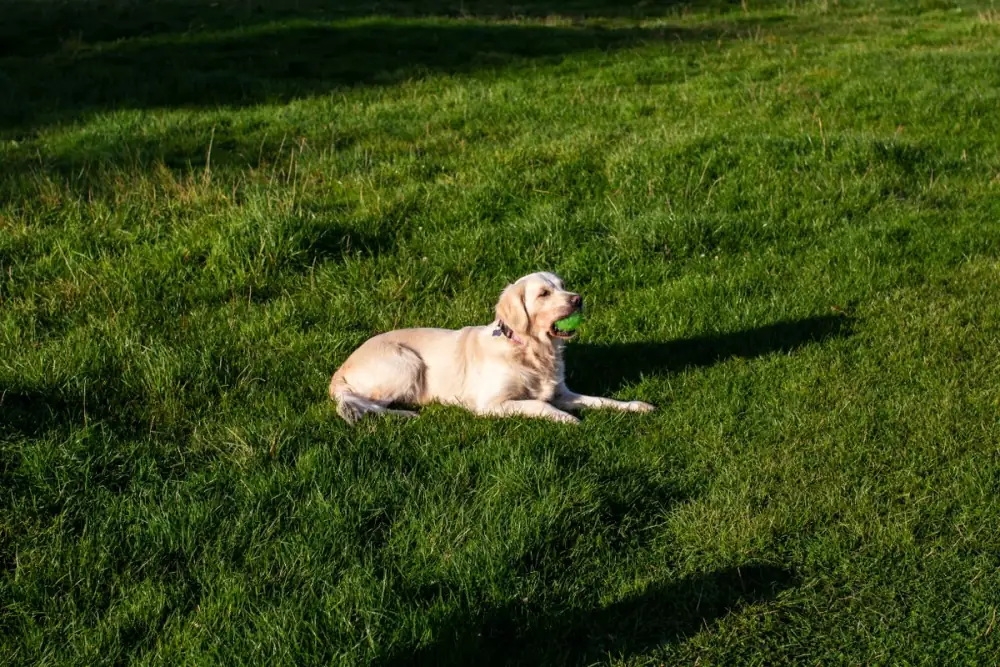
No grass is urine-proof — but the gap between species is real
Dog urine damages turf three ways at once: a concentrated slug of urea nitrogen, dissolved salts that pull water back out of the roots, and — the finding that reframed the problem — lactic acid, which NC State Extension identifies as the main culprit in the actual death of the grass, destroying cell membranes much the way some herbicides do. (Chemistry, green halo, and the four-step repair: dog urine spots on grass.)
Species tolerance is measured against that lactic acid load, and it splits along the warm-season / cool-season line. But chemistry is only half of what makes a lawn look good under a dog. The other half is growth habit:
- Spreading grasses (Bermuda, zoysia, Kentucky bluegrass) send out rhizomes or stolons and grow back into a dead spot on their own. NC State notes a warm-season lawn can close urine damage in as little as a couple of weeks when it's actively growing.
- Bunch grasses (tall fescue, perennial ryegrass) physically cannot creep sideways. Every spot they lose stays a hole until you put seed in it.
That's why the honest ranking needs two columns — and why the most chemically tolerant cool-season grass is also the one that leaves the most visible scars.
Urine tolerance by species
The cool-season ranking below comes from the NC State Extension review of the turf research (Li et al., 2019): tall fescue is the most lactic-acid tolerant, then creeping red fescue, then perennial ryegrass, with Kentucky bluegrass last. Warm-season Bermuda and zoysia sit above the whole cool-season group.
| Grass | Season | Urine tolerance | Self-repairs? | Notes for a dog yard |
|---|---|---|---|---|
| Bermudagrass | Warm | Highest | Yes — stolons + rhizomes | Most traffic-tolerant turf and fastest to recover. Full sun only; tan and defenceless all winter. |
| Zoysiagrass | Warm | Highest | Yes — but slowly | Very traffic-tolerant, denser than Bermuda, takes some shade. Slower to heal, so damage lingers. |
| Turf-type tall fescue | Cool | Best cool-season | No — bunch type | The default northern dog-yard grass. Deep roots, coarse blade, needs annual overseeding. |
| Creeping red fescue | Cool | Good | Weakly — short rhizomes | Second in the ranking and genuinely shade-tolerant, but thin-bladed and poor under heavy paws. |
| Perennial ryegrass | Cool | Moderate | No — bunch type | Germinates in 5–7 days: the fastest patcher, a nurse grass in the mix rather than the answer. |
| Kentucky bluegrass | Cool | Lowest | Yes — rhizomes | The most urine-sensitive lawn grass; its one saving grace is refilling its own spots. |
| St. Augustine | Warm | Not ranked | Yes — stolons | No urine-specific data; heavy stolons repair well, but coarse runners tear under a running dog. |
| Centipedegrass | Warm | Not ranked | Slowly — stolons | Low-input and slow-growing, so slow to recover. A poor match for an active dog. |
Two caveats. "Not ranked" means exactly that: the published urine work covers Bermuda, zoysia and the four cool-season species, so the last two rows are judged on recovery habit alone. And NC State flags real differences between cultivars — a top-rated turf-type tall fescue and a bargain-bin one are not the same purchase.
Why Bermuda and zoysia top the list
The warm-season pair wins twice. They tolerate more lactic acid than any cool-season grass, and they're built to grow back: Bermuda is the most traffic-tolerant turfgrass in general use and the quickest to recover, while zoysia is nearly as traffic-tolerant but slower to heal. Bermuda is the sprinter; zoysia is the tank — a dense springy carpet that resists being torn up at all.
The catch is dormancy. Both go tan after frost, and a dormant lawn has dramatically reduced wear tolerance and no ability to repair itself — so December's damage sits there until spring green-up. Bermuda adds a second limit: almost no shade tolerance, which rules it out under trees. And neither species survives north of the transition zone.
One practical note: hybrid Bermudas and most named zoysias are vegetative-only — no seed exists — so repairs mean sod, sprigs, or plugs 6–12 in (15–30 cm) apart. Common Bermuda is the seeded exception.
The cool-season answer: turf-type tall fescue
Where winter rules out Bermuda and zoysia, the choice is made for you: turf-type tall fescue is the most urine-tolerant cool-season grass there is, and it brings two more dog-relevant advantages. Its roots run far deeper than bluegrass, so the soil holds enough moisture to dilute a dose on arrival, and its coarse blade handles paw traffic better than the fine-textured grasses.
Its weakness is structural, not chemical: tall fescue grows in bunches and has no rhizomes, so a spot it loses stays lost. NC State is blunt that damaged tall fescue must be spot-seeded, plugged, or sodded, and that a badly hit lawn needs a full fall overseeding. A fescue dog lawn is a lawn you overseed every fall, permanently — that is the trade you make for the tolerance.
At the other end, Kentucky bluegrass is the species to stop buying for a dog yard: it burns from doses tall fescue absorbs invisibly. But don't rip it out on that alone — it's the one cool-season grass that regrows into its own dead spots. A small share of bluegrass in a mostly tall fescue blend is deliberate design: the fescue takes the hits, the bluegrass knits the gaps.
Cultivar matters nearly as much as species
The research behind the species ranking also found real differences between varieties within each species — so "tall fescue" on the front of the bag isn't the whole story. Prefer a blend naming three or more improved turf-type tall fescue cultivars, and check the seed test date: germination fades roughly 10% a year on the shelf.
Repair, overseed, or convert?
Swapping species isn't always the right move. Match the effort to the damage:
| Your situation | Best move | When | Realistic result |
|---|---|---|---|
| A few spots a season, lawn otherwise dense | Spot repair only — flush, rake, seed | Any time grass is growing | Spots gone in 4–6 weeks; no species change needed |
| 10–30 spots, tolerant species already | Whole-lawn overseeding | Early fall (cool-season) | One season resets the lawn |
| Bluegrass lawn, medium or large dog, weekly spots | Gradual conversion — overseed tall fescue each fall | Early fall, 2–3 years running | Mix drifts tolerant without a renovation bill |
| Dog zone is over a third of the lawn and thin throughout | Full renovation of that zone in one pass | Early fall (cool); late spring (warm) | Clean reset, but the dog is off it 3–4 weeks |
| Same corner stayed bare through two repairs | Leach the salts, or replace the top soil layer | Before you buy more seed | Seed finally takes — the problem was salt |
| Warm-season region, hybrid Bermuda or named zoysia | Plugs or sod, not seed | Late spring to early summer | Fills in over one growing season |
That salt row matters more than it looks: repeated doses in one corner accumulate faster than rain flushes them out, so a chronic target stays bare even after the dog is retrained. Flood it deeply before reseeding — technique in the bare patch repair guide.
Sure it's the dog and not something else?
Dog spots, dollar spot, and grub damage all read as "brown patches" from the deck — and each one takes a different fix. Photograph the patch and Lawn Care AI's Lawn Doctor names the cause, identifies your grass species, and puts the right repair into your lawn's schedule.
Converting a dog yard — and what the seed bag really tells you
Start with the label, because "pet-friendly" and "urine-resistant" have no legal definition on a seed bag — nobody audits those words. The species list on the back is the only regulated part:
- Cool-season dog yard: a blend that is mostly turf-type tall fescue, naming several improved cultivars. Perennial ryegrass at roughly 10–20% adds fast cover; a small share of Kentucky bluegrass adds self-repair.
- Reject: anything listing annual ryegrass (gone within a year), a high "other crop" or weed-seed percentage, or a mix built mainly on Kentucky bluegrass.
- Warm-season dog yard: common Bermuda comes as seed; hybrid Bermuda and quality zoysias are vegetative-only, so plugs or sod. Shop repair kits are usually ryegrass and will look wrong in a warm-season lawn.
The conversion itself is just overseeding aimed at a species change:
- Time it. Cool-season: early fall, at least 45 days before your first expected frost. Warm-season: late spring to early summer, once soil holds 65°F (18°C) or above.
- Open the soil. Mow one notch shorter than usual, then rake hard or core-aerate — seed has to touch mineral soil, not thatch.
- Rate. Overseeding tall fescue into living turf runs 4–6 lb per 1,000 sq ft (20–29 g/m²); bare ground needs the new-lawn rate of 8–10 lb per 1,000 sq ft (39–49 g/m²). More is not better — crowded seedlings damp off.
- Water like a nursery. Lightly once or twice a day to keep the top 1/2–1 in (1–2 cm) moist until germination, then shift gradually toward deep and infrequent over 2–3 weeks.
- Keep the dog off for 3–4 weeks. This is the step that fails. Fence it, or convert half the yard at a time so the dog still has somewhere legal to go.
Repeat every fall and the species mix drifts toward tolerance without a renovation invoice — method and timing in the overseeding guide. Not sure what you're starting from? Identify your grass first.
Design beats genetics: the dog-friendly yard
Every extension source on this topic reaches the same conclusion, and it isn't a grass species. NC State calls training the dog to use a mulched area or the lawn's periphery the single best solution — patience up front, then the problem ends permanently. No seed can claim that.
- A potty zone. A mulched, gravelled, or artificial-turf corner, ideally one the dog already favours. Leash walks there for 1–2 weeks with heavy rewards; most dogs generalize fast.
- Give the fence line up. Dogs wear a track along fences with a view of the street — NC State documents this exact pattern. Mulch, gravel, or a planted border beats reseeding it forever.
- Spread the traffic. Opening up a larger area, or cutting the time the dog spends on one patch, prevents the wear that compounds urine damage.
- Keep the lawn irrigated. Urine damage is worse on dry soil, on turf that isn't actively growing, and at high air temperatures — all three describe an unwatered August lawn. Hold the 1 in (2.5 cm) weekly routine through dry spells.
- Feed on schedule. A well-fertilized lawn is less affected by the nitrogen and salt load, and the green halos disappear into a uniformly dark lawn instead of glowing against a hungry one — when to fertilize.
- Mow tall. Tall fescue at 3–4 in (7.5–10 cm), Bermuda at 1–2 in (2.5–5 cm), zoysia at 1–2.5 in (2.5–6 cm). Deeper roots reach more moisture, and a taller canopy shades the crabgrass that colonizes every urine spot — mowing heights.
The watering can by the back door
The cheapest tool in this guide. University of Missouri Extension found that roughly three times the urine volume, applied within about 8 hours, flips the outcome from burn to fertilizer effect — salts wash below root depth and the grass usually recovers on its own. No species is as effective as that habit. Full method on the dog urine spot repair page.
Urine spot or disease? Check before you reseed
Converting to a tolerant species solves nothing if the spots were never urine. NC State warns that dog patch gets confused with dollar spot, brown patch, fairy ring, and spring dead spot. Two rules split them: urine spots carry an actively growing, darker green rim; disease patches don't, and diseased blades look water-soaked and mat down flat.
| What you see | Urine spot | The look-alike |
|---|---|---|
| Size and shape | Round, roughly 3–6 in (8–15 cm), straw-coloured centre | Dollar spot: coin-sized bleached spots, hourglass lesions on the blades |
| The ring | Rim greener and growing faster than the lawn | Brown patch: grey or smoke-coloured margin, blades water-soaked and matted |
| Mushrooms or a dark green arc | Not a urine pattern — halos are small and centred on one spot | Fairy ring: an expanding circle, often metres across |
| Turf lifts like carpet | Roots intact; grass dead but anchored | Grubs: roots chewed off, sod peels back with no resistance |
| Where it sits | Along the dog's routes — door, fence, path | Disease follows shade, poor airflow, overnight leaf wetness |
Still ambiguous? Work through the brown patch differential before spending on seed or fungicide.
Five mistakes that undo a tolerant lawn
- Buying the claim instead of the label. "Pet-friendly grass seed" is a marketing phrase. Turn the bag over and read the species percentages — the only regulated part.
- Planting tall fescue and mowing it like bluegrass. Scalped to 2 in (5 cm), fescue loses the root depth its tolerance depends on. Mow at 3–4 in (7.5–10 cm) or you bought the species and threw away the benefit.
- Letting the dog back on at day four. New seedlings have no anchorage; a spot re-christened in week one is a repair you get to do twice.
- Reseeding a salt-loaded corner without leaching it. Repeat doses accumulate faster than rain removes them. Flood it deeply several times — or swap the top few inches of soil — before any seed goes down.
- Reaching for supplements, gypsum, or baking soda. Extension guidance rejects all of them: gypsum and baking soda neutralize nothing relevant, and urinary acidifiers like dl-methionine or ammonium chloride never touch the nitrogen load while raising the risk of bladder crystals and stones. Never use them without your vet's explicit direction.
Dog urine resistant grass FAQ
What is the most dog urine resistant grass?
Bermudagrass and zoysiagrass, where climate allows them. NC State Extension reports that both warm-season species tolerate the lactic acid in dog urine better than cool-season grasses, and both spread by runners, so they close the spots they do get. Where winters rule them out, turf-type tall fescue is the most urine-tolerant cool-season species, ahead of creeping red fescue and perennial ryegrass.
Is there a dog urine resistant grass seed?
There is no legal definition of pet-friendly or urine-resistant on a seed bag, so the claim on the front tells you nothing — the species list on the back does. For a cool-season lawn, look for a blend that is mostly turf-type tall fescue and light on Kentucky bluegrass; for a warm-season lawn, common Bermuda seed or zoysia plugs.
What is the best grass for dogs that pee a lot?
Match the species to your climate first, then take the most tolerant option in that group: Bermuda or zoysia in the South, turf-type tall fescue in the North and transition zone. Then stack the odds — a designated potty area, a moist well-fed lawn, and a watering can by the door do more than any species swap on its own.
Will tall fescue survive dog urine?
It survives doses that kill Kentucky bluegrass, which is why it is the standard recommendation for a northern dog yard. The catch is that tall fescue grows in bunches and cannot creep sideways, so any spot it does lose stays open until you seed it. Plan on annual fall overseeding to keep a fescue dog lawn dense.
Should I replace my Kentucky bluegrass lawn because of my dog?
Rarely all at once. Kentucky bluegrass is the most urine-sensitive lawn species, but it also spreads by rhizomes and refills its own spots, which softens the loss. The usual answer is to shift gradually — overseed turf-type tall fescue each fall for two or three seasons and let the mix drift toward tolerance.
Does artificial turf solve dog urine spots?
It removes the burn, because there is nothing living to kill, but it does not remove the urine — salts and organic residue stay in the infill and smell, so it needs rinsing and an enzyme cleaner. A small artificial or mulched potty corner beside a real lawn gets the benefit without paving the yard.
Sources
- NC State Extension: Dogs and Turfgrass Interactions
- NC State Extension: Carolina Lawns — A Guide to Maintaining Quality Turf in the Landscape
- Clemson HGIC: Selecting a Lawn Grass
- University of Missouri Extension: Beautiful Lawns and Pets
- University of Maryland Extension: Improving a Struggling Lawn and Repairing Damage
- Penn State Extension: Lawn Establishment