Why is my grass turning yellow?
Yellow grass is your lawn's check-engine light: it tells you something is wrong, but not what. Chlorophyll — the pigment that makes grass green — is expensive for the plant to maintain, and it's the first thing grass sacrifices under stress. The good news: the pattern of the yellowing almost always points to the cause. Whole-lawn fading means nutrition. Spots mean dogs or disease. Yellow that follows your mower means the mower. Match your lawn to the patterns below and apply the right fix, not a guess.
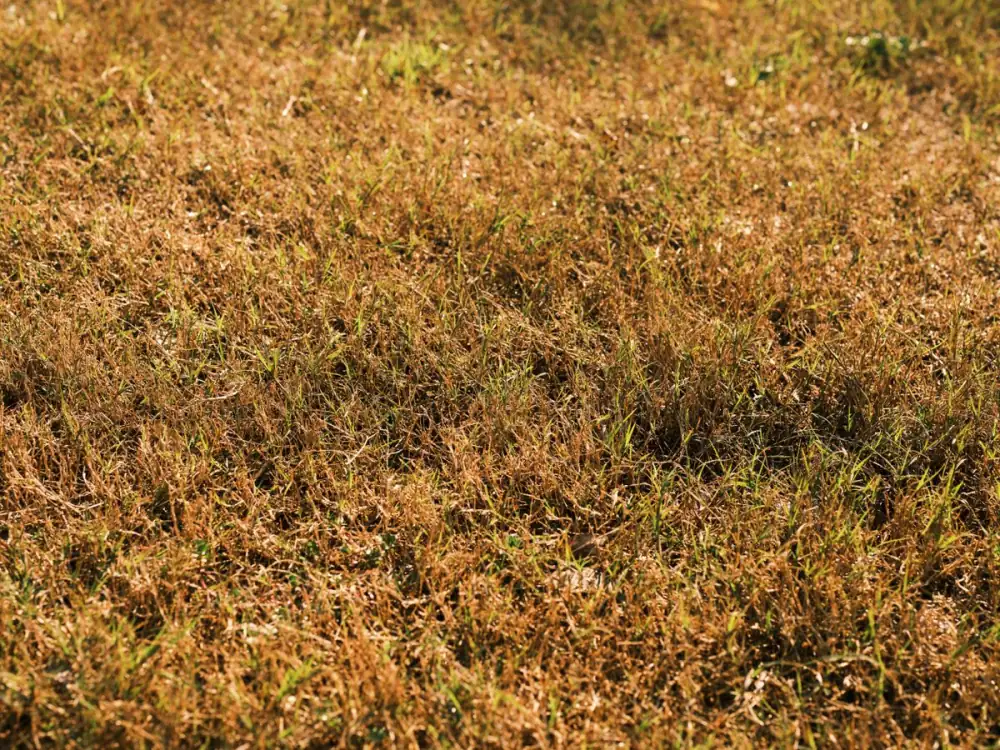
Read the pattern first
| What you see | Most likely cause | Fix difficulty |
|---|---|---|
| Whole lawn fading to pale yellow-green, slow growth | Nitrogen deficiency | Easy — feed |
| Yellow blades with green veins, worse in heat | Iron deficiency (high-pH soil) | Easy — iron |
| Yellow + spongy footing, mushrooms, moss | Overwatering | Easy — stop |
| Straw-yellow in sun-baked areas, footprints linger | Drought stress / dormancy | Easy — soak |
| Small yellow-brown spots ringed with dark green | Dog urine | Moderate |
| Yellow circles, flecks, or orange dust that spreads | Fungal disease | Moderate |
| Yellow tips right after mowing, ragged cuts | Scalping or dull blade | Easy — sharpen |
| Yellow stripes or patches days after fertilizing | Fertilizer burn | Moderate |
1. Nitrogen deficiency — the hungry lawn
Grass is one of the most nitrogen-hungry plants you can grow — a healthy lawn wants roughly 8–12 g of nitrogen per m² per year (about 2–4 lb per 1,000 sq ft), split across the growing season. A lawn that never gets fed fades evenly from deep green to pale yellow-green, thins out, grows slowly, and gets pushed around by weeds like clover that make their own nitrogen.
How to confirm: the yellowing is uniform across the whole lawn, and older (lower) leaves yellow first — nitrogen is mobile inside the plant, so it cannibalizes old growth to feed new. Growth is visibly slow: if you're mowing half as often as the neighbors, this is your sign.
Fix: apply lawn fertilizer in the right window for your grass type — fall-heavy for cool-season lawns, late spring through summer for warm-season. A slow-release nitrogen source gives 6–8 weeks of steady color instead of a two-week surge. Expect visible greening in 5–10 days. Our fertilizing guide covers timing, rates, and product types.
2. Iron deficiency — yellow blades, green veins
If the lawn yellows even though you feed it, look closely at a single blade: yellow tissue between veins that stay green is iron chlorosis, not nitrogen hunger. Iron is essential for building chlorophyll, and in alkaline soil (pH above ~7) it gets locked into forms roots can't absorb — the iron is in the soil, just unavailable. It shows first on the newest leaves (iron is immobile in the plant — the mirror image of nitrogen) and worsens in hot weather and wet, compacted soil.
Fix: a chelated iron product (look for Fe-EDDHA or Fe-DTPA on the label — plain iron sulfate works but stains concrete rust-orange) greens the lawn within days without pushing extra growth. That's the quick fix; the durable one is knowing your soil pH. If it's above 7.5, elemental sulfur applied over a couple of seasons brings it down slowly. This is exactly the call a soil test settles — the app's soil test scanner reads your results and tells you whether you're in nitrogen or iron territory.
Nitrogen or iron? The 60-second test
Yellowing old leaves first, whole plant, slow growth → nitrogen. Yellowing new leaves first, green veins, normal growth speed → iron. If you apply nitrogen to an iron-deficient lawn you get faster-growing yellow grass — now you're mowing more often for nothing.
3. Overwatering — drowning roots turn yellow
Roots need oxygen as much as they need water. Waterlogged soil has neither air pockets nor active microbes, so roots suffocate, rot at the tips, and stop taking up nutrients — the lawn yellows even though everything is "well watered." Overwatering also physically washes nitrogen below the root zone, stacking a nutrient problem on top of the oxygen problem.
How to confirm: spongy footing, moss or mushrooms appearing, thatch building up, yellowing worst in low spots and along irrigation heads, soil that smells sour when you dig a plug. If you water daily "just a little," this is almost certainly you.
Fix: stop watering entirely until the top 5–8 cm (2–3") are dry — push a screwdriver in to check. Then switch permanently to deep, infrequent sessions: about 2.5 cm (1") per week including rain, in one or two sessions. Core-aerate compacted areas in fall so water drains instead of pooling. Recovery takes 2–4 weeks as new root tips grow.
4. Drought stress — yellow on the way to brown
Underwatered grass goes through a predictable sequence: first a dull blue-gray cast and footprints that stay visible (blades too limp to spring back), then yellowing, then straw-brown dormancy. It starts where soil is shallowest or sun is strongest — slopes, south edges, strips along pavement where radiated heat dries soil fastest.
Fix: one deep soak — enough to wet the top 15 cm (6") — revives yellow-stage drought stress within days. If parts have already gone fully brown in a heat wave, the lawn has entered protective dormancy: the crowns are alive and waiting. Either water deeply once every 2–3 weeks to keep crowns alive while letting it sleep, or resume full irrigation and expect green-up in 10–14 days. What kills lawns is alternating — reviving it, letting it collapse, reviving it again burns the crown's energy reserves.
5. Dog urine — yellow spots with a green halo
Concentrated urine delivers a nitrogen overdose: it burns the center of the spot yellow-brown while the diluted edge gets a fertilizer boost — hence the telltale dead center with a dark-green ring. Disease rings are tan or gray; urine rings are greener than the surrounding lawn. Spots cluster where the dog patrols: near the door, along the fence.
Fix: flush fresh spots with water, reseed dead centers. Full repair walkthrough and prevention (including which myths to skip) in the dog spot guide.
6. Disease — yellow that spreads in shapes
Fungal problems announce themselves with geometry and movement — yellowing that expands over days and follows moisture:
- Rust: blades yellow, then develop orange pustules that powder your shoes and mower. Common in late summer on slow-growing, underfed lawns.
- Dollar spot: bleached-tan spots the size of a coin to a hand, often with an hourglass-shaped lesion on individual blades. Low-nitrogen lawns in humid weather.
- Brown patch: yellow-tan circles up to a meter wide appearing overnight in warm, humid spells — the brown patch guide covers the differential in depth.
- Snow mold: matted yellow-gray patches revealed at spring thaw, especially under long grass that went into winter unmowed.
Fix: most lawn fungi are managed culturally — water only in early morning, mow with a sharp blade when grass is dry, feed correctly (rust and dollar spot follow underfed lawns; brown patch follows summer overfeeding), and improve airflow. Fungicides are the escalation for lawns that get the same disease every year. Match symptoms in the disease guide, or scan the patch with the app's Lawn Doctor.
7. Mowing stress — yellow tips, ragged cuts
Two separate crimes with the same sentence. Scalping — cutting more than a third of the blade at once — removes so much photosynthetic area the plant yellows from shock. A dull blade tears instead of slicing, leaving shredded tips that dehydrate white-yellow within a day; the lawn looks uniformly frosted right after mowing.
Fix: sharpen the blade at least once per season (twice with a big lawn), and follow the ⅓ rule — for cool-season lawns that means mowing at 7.5–10 cm (3–4"). If the lawn got away from you on holiday, bring it down in two or three mows spaced a few days apart, never in one.
Not sure which one is your lawn?
Photograph the yellow area and Lawn Care AI's Lawn Doctor diagnoses the likely cause — nutrient, water, disease, or pest — and gives you a step-by-step treatment plan for your exact grass type and local weather.
Is it dead — or just yellow?
Two 10-second tests before you panic:
- Tug test: grab a handful of yellow grass and pull. Firm resistance = living roots, the lawn can recover in place. Lifts like loose carpet = grub damage; pulls free with black, rotten roots = overwatering or disease.
- Crown check: part the yellow blades and look at the base of the plant. White-green, firm crowns mean it will regrow even if every blade is yellow; brown, brittle crowns mean that spot needs reseeding.
What recovery looks like (so you don't over-correct)
| Cause | Time to green after fix | If nothing changes by then… |
|---|---|---|
| Nitrogen | 5–10 days | Re-check for iron or compaction |
| Iron (chelated spray) | 2–5 days | Test soil pH — may need sulfur long-term |
| Drought (yellow stage) | 3–7 days after deep soak | Check for grubs or buried debris |
| Overwatering | 2–4 weeks after drying out | Aerate; check drainage |
| Disease | 1–3 weeks after conditions change | Consider targeted fungicide |
| Fertilizer burn / urine | Won't re-green — reseed dead centers | — |
The biggest mistake with a yellow lawn is stacking fixes — feeding, watering more, and spraying in the same week. Change one thing, give it its recovery window, and you'll know what actually worked.
Yellow grass FAQ
Why is my grass yellow even though I water it?
Frequent watering is often the cause, not the cure. Daily light watering starves roots of oxygen and leaches nitrogen away, both of which yellow the lawn. Switch to deep, infrequent sessions and feed if it hasn't been fertilized this season.
Does yellow grass mean it's dead?
Usually not — yellow is stressed, not dead. Use the tug test: firm roots mean it can recover. Grass only dies when the crown at the base is killed.
Will yellow grass turn green again?
Yes, if you fix the cause. Nutrient fixes green up in under two weeks; drought recovery takes one deep soak; disease and grub damage may need overseeding in the dead spots.
What fertilizer fixes yellow grass?
Whole-lawn pale yellow wants nitrogen; yellow-between-green-veins wants chelated iron. A soil test settles it — scan yours with the app and it tells you exactly what's missing.
Why is my grass yellow in spring?
Usually a hungry lawn waking up, cold wet soil limiting iron uptake, or snow mold patches from winter. A feeding once soil passes ~10°C (50°F) fixes the first two within a couple of weeks.
Can too much fertilizer turn grass yellow?
Yes — fertilizer burn. Yellow-then-brown stripes or patches days after feeding, matching the spreader path. Flush with water daily for several days; reseed anything that goes straw-brown.