What kind of grass do I have?
Almost every lawn care decision — how short to mow, how much to water, when to fertilize — depends on your grass type. Care for tall fescue like it's Bermuda and you'll scalp it; feed Kentucky bluegrass on a Bermuda schedule and you'll mostly feed the weeds. Here's how to identify what's actually growing in your yard.
The fastest way: scan it with AI
Manual grass identification works, but it takes a hand lens and some patience. If you just want the answer, take a photo: an AI grass identifier compares blade width, color, sheen, and growth pattern against known species and names your grass in seconds — then tells you how to care for it.
Identify your grass from one photo
Lawn Care AI names your grass type, spots weeds and diseases, and builds a care schedule around the result. Free to download.
Step 1 — Narrow it down by region
Grass species split into two families, and your climate rules out half the candidates immediately:
- Cool-season grasses (Kentucky bluegrass, perennial ryegrass, tall and fine fescue) dominate the northern half of the US, Canada, and most of Europe. They grow fastest in spring and fall and stay green through cold winters.
- Warm-season grasses (Bermuda, zoysia, St. Augustine, centipede) dominate the South. They love 80–95°F heat, and they turn brown and dormant after the first frost — that winter browning is normal, not dead grass.
- The transition zone (roughly a band from the mid-Atlantic across to Kansas) can grow both; tall fescue and zoysia are the usual picks.
Start from where you live and play the odds — most lawns are one of the few grasses common to their region:
- Upper Midwest & Northeast: almost always a cool-season blend of Kentucky bluegrass, perennial ryegrass, and fine fescue.
- Deep South: St. Augustine, centipede, or Bermuda.
- Southwest & arid West: Bermuda or zoysia, which shrug off heat and drought.
- Transition zone: tall fescue or zoysia, the two grasses that survive both the hot summers and cold winters there.
These are priors, not a diagnosis — but they tell you which two or three candidates to check first before you reach for a hand lens.
Step 2 — Look at blade, tip, and growth habit
Pull a few blades from a healthy patch and check three things:
- Blade width and texture. Needle-fine (fine fescue, Bermuda, zoysia), medium (Kentucky bluegrass, ryegrass, centipede), or wide and coarse (tall fescue, St. Augustine).
- Leaf tip. A boat-shaped tip — pinch the tip flat and it looks like the bow of a canoe — means you have a bluegrass (a Poa species). That includes Kentucky bluegrass, rough bluegrass, and the annual bluegrass weed, so the boat tip narrows the family but doesn't finish the job. Ryegrass and fescue tips are pointed by comparison.
- How it spreads. Dig up a small plug. Grasses that spread by underground rhizomes (Kentucky bluegrass) or above-ground runners called stolons (rough bluegrass, Bermuda, St. Augustine) knit into a carpet. Bunch grasses (ryegrass, tall fescue) grow in distinct clumps that only thicken with overseeding. This spread habit is what separates Kentucky bluegrass (rhizomes, darker) from its look-alike rough bluegrass (stolons, yellower).
The 3 structural checks the pros use
Blade width and color get you close, but they change with mowing, shade, and fertility. When a university extension key needs to tell two grasses apart for certain, it looks at three tiny structures that don't lie. You'll need a whole tiller for this — pull up a single shoot with its crown and the sheath (the tube that wraps the stem), not just a detached blade. A hand lens helps, but you can do all three checks by eye and by feel.
- Vernation — how the youngest leaf is packed. Slice or gently roll the base of a young, unopened shoot between your fingers. If it feels flat and two-edged, the leaf was folded (Kentucky bluegrass, ryegrass, fine fescue). If it rolls like a round tube, it was rolled (tall fescue, Bermuda, St. Augustine). This is the single most reliable field check.
- Ligule — the little collar where blade meets sheath. Bend the blade back from the stem and look at the joint on the inside. You'll see one of three things: a thin papery flap (membranous), a fringe of tiny hairs (hairy), or nothing at all (absent). Its size and type are surprisingly species-specific.
- Auricle — claw-like appendages at the base of the blade. Look for two small tabs that reach around and clasp the stem, like tiny claws. Long clasping auricles point to perennial ryegrass or the weed quackgrass; short blunt ones suggest tall fescue; most lawn grasses have none.
| Grass | Vernation | Ligule | Auricle |
|---|---|---|---|
| Kentucky bluegrass | Folded | Short, membranous | Absent |
| Perennial ryegrass | Folded | Short, membranous | Small, claw-like |
| Tall fescue | Rolled | Short, membranous | Short, blunt |
| Fine fescue | Folded | Short, membranous | Absent |
| Bermuda | Rolled | Fringe of hairs | Absent |
| Zoysia | Rolled | Fringe of hairs | Absent |
| St. Augustine | Rolled (flat, folded-look) | Fringe of hairs | Absent |
Shortcut: start with vernation
Vernation alone splits the field in half. Roll a young shoot between your fingers — folded means bluegrass, ryegrass, or fine fescue; rolled means tall fescue or a warm-season grass. Then use the ligule and auricle to break the tie.
The most common lawn grasses
Kentucky bluegrass
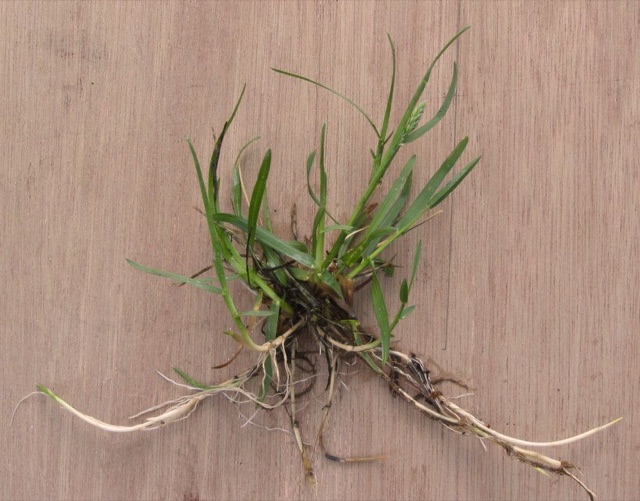
The gold standard of northern lawns: dense, dark blue-green, and self-repairing thanks to rhizomes. Look for the boat-shaped tip and a narrow, V-creased blade. It needs more water and feeding than fescue, and it goes dormant (brown) in summer drought rather than dying. Mow 2.5–3.5".
Perennial ryegrass
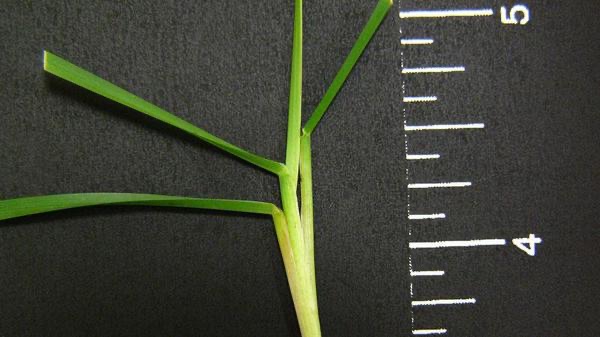
The sprinter — germinates in under a week, which is why it anchors most overseeding mixes. Fine pointed blades with a distinctly glossy underside and reddish base at the crown. Bunch-forming, so bare spots need reseeding. Mow 2–3".
Tall fescue
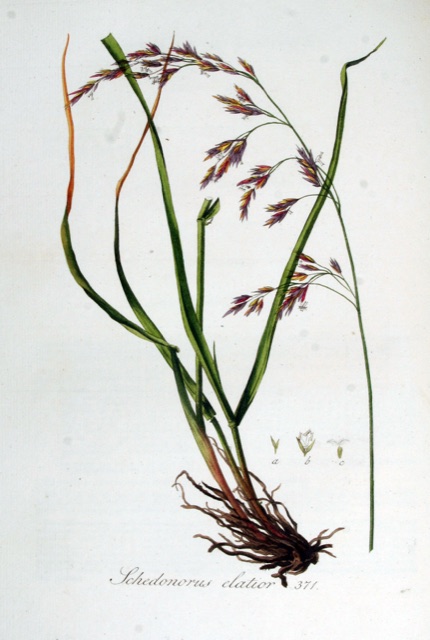
Wide, coarse blades with visible ribs on the upper surface and a bunching habit. Its deep roots make it the most drought- and heat-tolerant cool-season grass — the default choice in the transition zone. Mow high at 3–4" and it will shade out most weeds itself.
Fine fescue
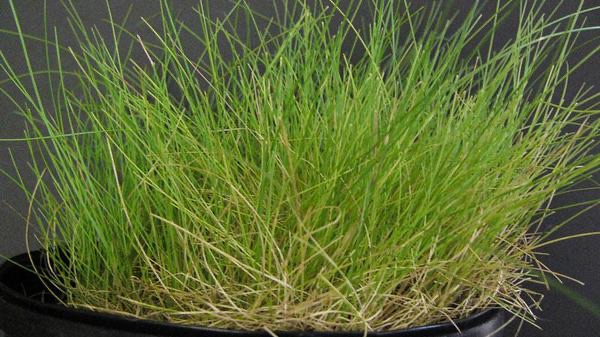
If the blades look like needles or wires, it's a fine fescue (creeping red, chewings, hard fescue). The shade-and-neglect specialist: it tolerates poor soil, low fertilizer, and deep shade better than any other lawn grass, but hates heavy traffic and soggy soil.
Bermuda grass
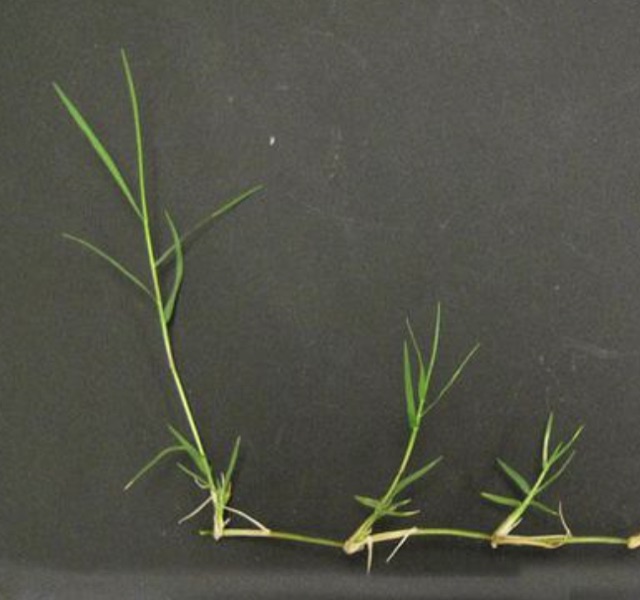
The South's favorite: fine-textured, gray-green, and aggressive, spreading by both stolons and rhizomes — you'll see wiry runners crawling across sidewalks. Full sun only. Mow low (1–2"), feed through summer, and expect straw-brown dormancy after frost.
St. Augustine
The coarsest common lawn grass and the one most people picture when they think "Florida lawn." Blades are broad — 8–10 mm across — with a blunt, almost boat-ish tip, and they sit in an unmistakable opposite arrangement along thick, flat above-ground stolons that you can trace across the soil by hand. For a warm-season grass it is remarkably shade-tolerant, which makes it the default under coastal live oaks. Spreads by stolons only (no rhizomes), so it repairs bare spots but jumps beds and walks easily. Mow high at 3–4".
Zoysia
The dense carpet: fine, stiff blades just 2–3 mm wide with rolled vernation, packed so tightly you can feel the springy thatch underfoot. Spreads by both rhizomes and stolons, so it fills in — but slowly, which is why zoysia sod and plugs cost more than seed-grown lawns. Excellent heat, drought, and traffic tolerance make it a transition-zone favorite; it goes tan-dormant after frost like other warm-season grasses. Mow 1–2.5".
Centipede
The low-input grass of the Southeast, easy to spot by its distinctive yellow-green "apple" color — noticeably paler than Bermuda or zoysia. Blades are 2–4 mm wide and set alternately (not opposite, like St. Augustine) along stolons; it spreads by stolons only. It wants acidic soil, little fertilizer, and little mowing — over-feed it and you'll kill it with kindness ("centipede decline"). Mow 1.5–2".
Rough bluegrass
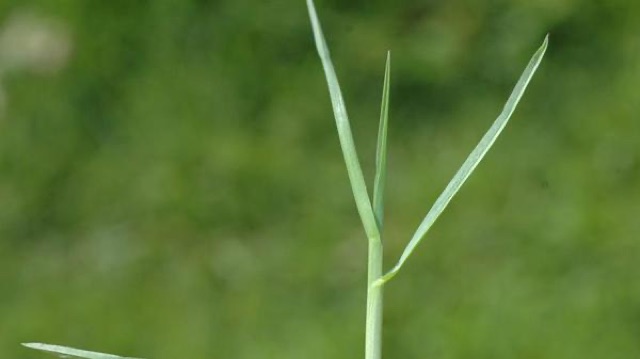
Bluegrass's shade-loving cousin: lighter, yellow-green color, glossy blades, and a shallow-rooted, stoloniferous habit. It thrives in damp shade where Kentucky bluegrass fails — then browns out fast in hot, dry sun. Often shows up uninvited as lighter patches in older lawns.
Quick comparison
| Grass | Season | Blade | Spreads by | Mow height |
|---|---|---|---|---|
| Kentucky bluegrass | Cool | Medium, boat tip | Rhizomes | 2.5–3.5" |
| Perennial ryegrass | Cool | Fine, glossy back | Bunch | 2–3" |
| Tall fescue | Cool | Wide, ribbed | Bunch | 3–4" |
| Fine fescue | Cool | Needle-fine | Bunch / weak rhizomes | 2.5–3.5" |
| Bermuda | Warm | Fine, gray-green | Stolons + rhizomes | 1–2" |
| Zoysia | Warm | Fine, stiff | Stolons + rhizomes | 1–2.5" |
| St. Augustine | Warm | Wide, coarse | Stolons | 3–4" |
| Centipede | Warm | Medium, yellow-green | Stolons | 1.5–2" |
| Rough bluegrass | Cool | Fine, glossy, light | Stolons | 2.5–3" |
Commonly confused pairs
Two matchups trip up almost everyone. Both come down to the structural checks above.
Tall fescue vs. perennial ryegrass
Both grow in bunches and have similar dark-green color, so people mix them up constantly. Separate them this way: ryegrass has a bright, waxy gloss on the underside of the blade and small claw-like auricles that clasp the stem; tall fescue is dull, its auricles are short and blunt, and its blade is noticeably wider with prominent ribs on top. If you're still unsure, roll a young shoot — ryegrass is folded, tall fescue is rolled.
Kentucky bluegrass vs. rough bluegrass
Both carry the boat-shaped Poa tip, so the tip won't decide it. The tell is how they spread and their color: Kentucky bluegrass runs on underground rhizomes and is a deep blue-green; rough bluegrass creeps by above-ground stolons, leans yellow-green, has a glossy sheen, and shows up as lighter patches in damp shade where Kentucky bluegrass thins out.
Is it actually a weed grass?
Sometimes the "grass you can't identify" is a weedy grass that seeded itself in. Unlike your turf, these won't blend in — they differ in color, texture, or growth rate enough to stand out as patches — and they usually need spot treatment or a fall renovation rather than ordinary care. A few common culprits:
- Quackgrass: long clasping auricles, blue-green blades, and aggressive white underground rhizomes that make it spread fast through a lawn.
- Orchardgrass: a strongly folded, V-keeled shoot you can feel as a sharp ridge, blue-green color, and fast-growing clumps that outrun the mowing you just did.
- Crabgrass: a sprawling summer annual with wide, short blades that fan out flat from a central point and die off completely at the first frost.
- Nimblewill: thin wiry stolons, fine blue-green blades, and an early-fall browning that leaves obvious dead patches while the rest of the lawn is still green.
If one of these is taking over, identifying it is only step one — see our guide to common lawn diseases and weeds for how to treat each without wrecking the grass you want to keep.
Identifying a stressed late-summer lawn
Late summer is when most grass IDs go wrong, and the reason is simple: the two features people identify by — colour and blade width — are the two that change most under heat and drought. A drought-stressed Kentucky bluegrass goes blue-grey and then straw; ryegrass thins out and looks finer than it is; tall fescue holds green longer than everything around it and gets mistaken for a different lawn entirely. None of that tells you the species.
The structural checks above are the way through, because they're anatomy rather than condition. Vernation, ligule, and auricle look the same on a stressed plant as on a lush one — you only need one living tiller to read them. In August, look for that tiller where the lawn still has water:
- Within 3 ft (1 m) of a sprinkler head, hose bib, or downspout — the reliably wettest turf in the yard.
- The shaded strip on the north side of the house, which loses far less to evaporation. Be aware that deep shade also favours fine fescue and rough bluegrass, so confirm your find against a sunnier patch later.
- Along bed edges and under the drip line of trees, where roots reach moisture the open lawn can't.
Then use the season itself as evidence. In August a cool-season lawn looks its worst and a warm-season lawn looks its best — so a yard that is half lush green and half straw in the same week usually has two species in it, not one problem. The usual culprits are Bermuda or nimblewill spreading into a cool-season lawn.
Two quick reads that save a wasted diagnosis:
- Green patches in a brown lawn are rarely your grass. Coarse blades sprawling flat from a central clump is crabgrass; fine, wiry, blue-green mats that will brown early in fall are nimblewill; coarse dark bunches outgrowing everything are tall fescue clumps. All three are covered in the weed identification guide.
- Brown patches in a green lawn need the dormancy check first. Dormant grass holds firm when you tug a handful; dead grass pulls out with no resistance — the full test is in dead or dormant?
And if nothing in the lawn is green enough to read, wait. Cool-season grasses become easy to identify again after the first cool, wet week of September — which is also when you'd be overseeding, so the delay costs you nothing.
Grass identification FAQ
Can I identify grass from a photo?
Yes. AI grass identifier apps like Lawn Care AI recognize grass type from a single photo of your lawn by analyzing blade width, color, and growth pattern — much faster than manual identification, and accurate enough to build a care plan on.
What's the difference between cool-season and warm-season grass?
Cool-season grasses grow best at 60–75°F, stay green in cold climates, and grow fastest in spring and fall. Warm-season grasses thrive at 80–95°F, dominate southern lawns, and go brown and dormant after frost.
Can a lawn have more than one grass type?
Very often, yes. Most northern lawns are seeded with a blend — typically Kentucky bluegrass, perennial ryegrass, and fine fescue — so different patches of the same lawn can look and behave differently. Identify the dominant grass and care for that.
How do I tell tall fescue from ryegrass?
Both are bunch-type grasses with similar dark-green color. Perennial ryegrass has a bright, waxy gloss on the underside of the blade, small claw-like auricles that clasp the stem, and a folded young shoot. Tall fescue is dull, its blade is wider with prominent ribs on top, its auricles are short and blunt, and a young shoot is rolled rather than folded.
Sources
The identification method here follows the structural keys used by university turf programs: